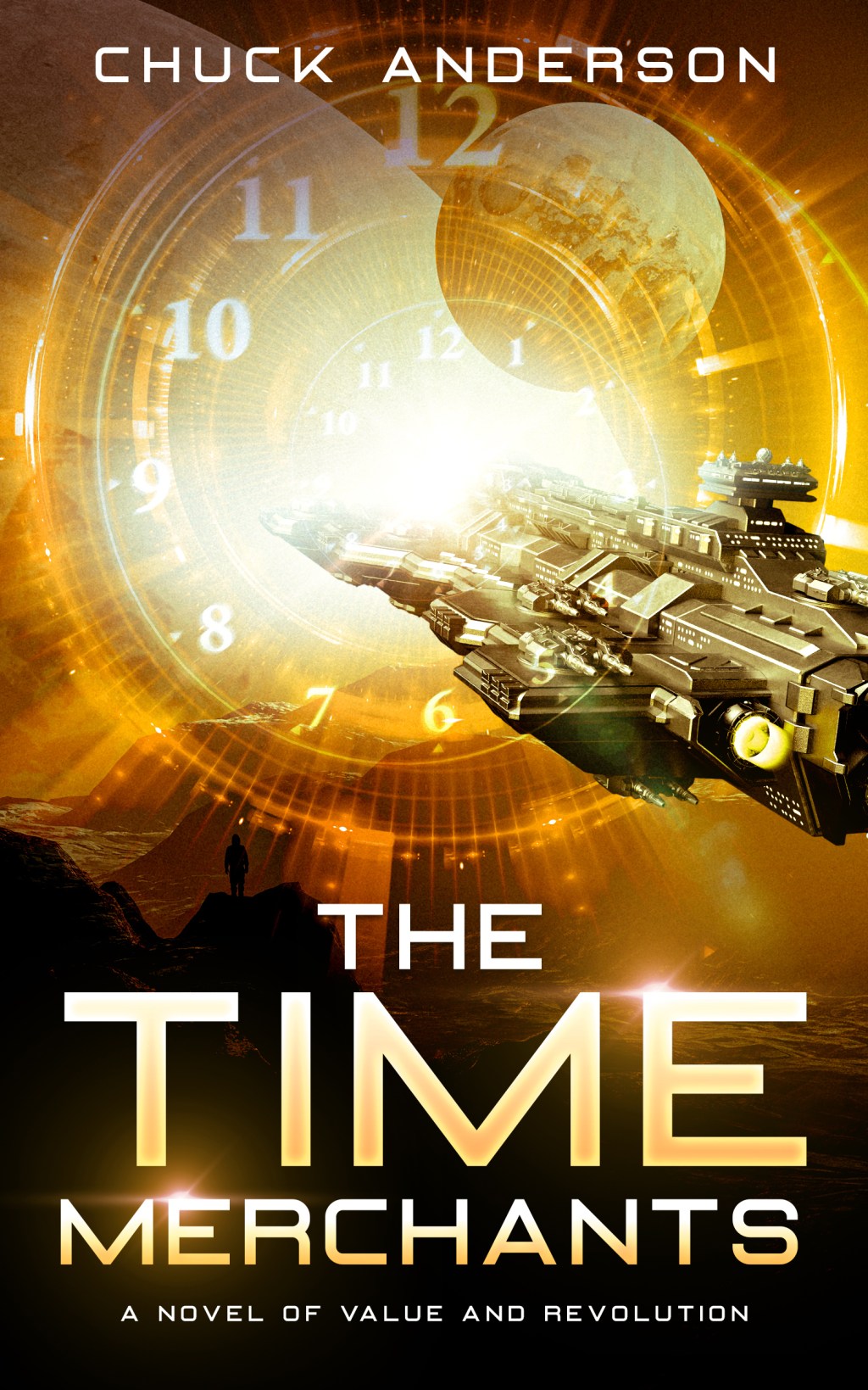
Prelude
The Value of an Hour
The old saying was wrong. Time isn’t money—time is everything.
I was twelve when the global markets collapsed, perched on our apartment’s threadbare couch while my parents clutched each other’s hands, their faces lit by the sickly glow of their screens. I watched digital fortunes evaporate worldwide, leaving nothing but zeroes in their wake. Currency became worthless overnight. Billions lost everything they’d spent generations building. The streets filled with the desperate and the angry, their life savings reduced to ghostly strings of meaningless numbers.
But humans are nothing if not adaptable. Some might say we’re like cockroaches that way.
We built something new from the ashes of the old system—or instead, the Timekeepers did. They emerged from the chaos like prophets, offering their elegant solution: if money had failed us, they said, we would trade in the one commodity everyone had in equal measure: time.
The math was beautiful and seductive in its simplicity. Every hour of work, no matter what kind, would be worth the same. One hour of teaching equals one hour of farming equals one hour of coding. A doctor’s time is worth no more or less than a street sweeper’s. They reminded us that we all have twenty-four hours in a day. For the first time in human history, we would start truly equal.
The Timekeepers built their precious ledger—a sprawling digital tapestry of encrypted data recording every breath, every motion, every second of human labor. I remember the day they unveiled it on the massive screens in Unity Square, lines of code scrolling like falling rain while the crowds stared in awe. “This is your guarantee of fairness,” they promised, their faces beaming down at us from above. “Time fraud undermines the very foundation of our new society.” Even then, at twelve, I noticed how they said ‘your guarantee’ and not ‘our guarantee.’ The Timekeepers always stood apart, watching from their towers as the rest of us exchanged our hours like copper coins.
When the world fell apart, I found peace in broken things. Machines don’t lie—they either work or they don’t. There’s a purity in that binary truth that drew me to engineering. Now, I spend my days breathing life back into the massive atmospheric processors that keep our arcology habitable. Twelve hours of crawling through maintenance shafts, debugging neural networks, and soldering quantum circuits earn me twelve credits. Simple. Fair. At least that’s what I told myself, watching those credits drain away for necessities—vat-grown food, automated healthcare, mandatory entertainment quotas. The same credits stretch twice as far for those working in the Timekeeper towers. But machines don’t lie, even when people do.
Last week, something caught my eye in the neural net’s diagnostic feed. Minor discrepancies at first—a minute here, an hour there, flickering through the system like digital ghosts. I thought the quantum processors were glitching until I saw Councilor Reed’s daughter walk out of a premium med-pod—a week’s worth of regenerative treatment for what should have cost a month’s credits. When I checked the public ledger, her account showed no unusual deductions.
The thing about time is that it’s supposed to be constant. Immutable. A minute is a minute is a minute.
Unless someone’s found a way to make their minutes count for more than yours.
My name is Leah Morgan, and I’m about to discover that some people have figured out how to bend the rules in a world where time equals power. They say time waits for no one, but that’s not entirely true.
Some people, it seems, have all the time in the world.
And I intend to find out why.
I ran the numbers thrice, cross-referencing public ledger transactions against the neural net’s raw data streams. The discrepancies weren’t random—they formed a pattern like ripples in still water. Every time a member of the Council or their family accessed premium services, the time-cost recordings flickered for a microsecond before settling on impossibly low values.
My discovery could have ended there. I should have, probably. Engineers who ask too many questions tend to find themselves reassigned to maintaining waste processing units in the lower levels. But I couldn’t let it go. Maybe the engineer in me could not ignore a system malfunction. Or perhaps it was the memory of my parents’ faces the day everything collapsed—that look of betrayal when they realized the system they’d trusted had been rigged all along.
I started small. During my maintenance rounds, I placed tiny quantum sensors near the med-pods frequented by the elite. The readings were fascinating—and impossible. According to the sensors, time slowed around these pods when certain people used them. Not much, just a fraction of a second’s difference, but enough to create a discount in the ledger.
Then Maya disappeared.
Maya was my best friend in the engineering corps, brilliant with quantum mechanics and fearless in calling out inefficiencies. Last month, she noticed similar discrepancies in the entertainment district’s time recordings. “It’s like they’re stretching time,” she’d whispered during our lunch break, her dark eyes intense. “Playing with it like putty.”
Three days later, her workspace was empty. Her quarters had been reassigned. According to the public records, she’d requested a transfer to an offshore atmospheric processing facility. But Maya was terrified of the ocean—had been ever since the rising seas swallowed her childhood home.
I knew then that I wasn’t just dealing with fraud. This was something bigger that struck at our new society’s very foundations. Someone had found a way to manipulate time, using it to maintain power just as the bankers of the old world had used their financial instruments.
The irony wasn’t lost on me. We’d replaced one rigged system with another.
I needed proof—something undeniable, something I could broadcast to every screen in the arcology. But how do you prove time isn’t flowing the same for everyone? How do you measure the immeasurable?
The answer came from an unexpected source. I found a forgotten maintenance terminal while repairing a quantum circuit in one of the older atmospheric processors. Its ancient display still showed timestamps from before the collapse, before the Timekeepers. As I stared at its steady pulse of numbers, a plan began to form.
The old machines didn’t lie. And they didn’t answer to the Timekeepers.
I would need help, though. And in a world where time equals power, trust is the most precious commodity. But I knew where to start—with the street sweeper I passed every morning on my way to work. The one who spent exactly eight hours cleaning the same spotless stretch of street outside the Timekeeper towers, his eyes always focused upward, watching.
He had noticed, too.
The thing about time manipulation is that it leaves traces—quantum echoes that ripple through reality. The Timekeepers might control the ledger, but they couldn’t control the laws of physics. Not completely.
Not yet, anyway.
I have seventy-two hours before my next mandatory “wellness review.” Seventy-two hours to gather evidence, find allies, and expose the truth. After that, I might also find myself volunteering for an offshore assignment.
They say the truth will set you free. But the truth might get you erased in a world where time is everything.
Part 1: Ghost MoneyChapter 1
Saigon Outskirts, April 29, 1975 – 0500 Hours
The radio crackled with static, then silence. Minh Phan pressed the headset closer to his ear, straining to hear anything beyond the empty hiss. Somewhere in that void of sound, North Vietnamese forces were moving toward Saigon. The morning fog clung to the ground like a funeral shroud, obscuring the horizon where he knew they waited, their tanks and troops advancing through the mist like ghosts of inevitable defeat.
“Here.” Private Tran offered him a cigarette, hands trembling slightly as he struck the match. “American brand. Lifted it from the embassy liaison last week.” The flame wavered in the damp air, casting shadows across his boyish face.
Minh accepted it, noting how the young private’s fingers shook. Around their sandbagged position, other soldiers of the 5th Battalion huddled in small groups, sharing their cigarettes in the pre-dawn gloom. They were all so young – most barely past twenty. Minh, at twenty-five, felt ancient among them, weathered by years of watching friends and ideals crumble under the weight of this endless conflict.
“Bet those communist bastards are still twenty kilometers out,” Corporal Duc declared too loudly, puffing out his chest. “Probably lost in the jungle.” A few nervous laughs rippled through the unit, hollow and forced. Minh said nothing, watching Duc’s eyes darted to the tree line every few seconds, betraying the false confidence in his words.
The radio squealed again, piercing through the morning stillness. “Charlie-Echo-Seven, report status.” The voice was tense, clipped, carrying undertones of barely contained panic.
“Charlie-Echo-Seven, holding position,” Minh responded, his engineer’s mind automatically analyzing the degrading quality of the transmission. “No visual contact. Requesting update on—”
The distant boom cut him off. Artillery fire, far enough to be just thunder, close enough to make the coffee cups rattle on their makeshift table and send ripples across the surface of day-old coffee. The laughter died. Private Tran dropped his cigarette, leaving a small burn mark on the sandbag at his feet.
Minh keyed the radio again, fighting to keep his hand steady. “Charlie-Echo-Seven to Command. Requesting status of northern positions.” Static answered, a harsh whisper of abandonment. He tried another channel. “Charlie-Echo-Four, do you copy?” Nothing. “Charlie-Echo-Two?” Silence, thick and oppressive.
The morning fog was lifting now, revealing empty guard posts along their line where sister units should have been. To the west, a column of black smoke rose like an accusation against the pale sky, its dark fingers reaching upward as if grasping for salvation. Private Tran made the sign of the cross – a habit from his Catholic school days that emerged only when truly frightened, his lips moving in silent prayer.
“Sir?” Duc’s voice had lost its bravado, stripped bare of pretense. “Those posts were manned an hour ago.” His words hung in the air like the smoke from their cigarettes.
Minh looked down at the radio, its green metal case scratched and dented from years of service. Like everything else in this war, it was a hand-me-down from the Americans, who had already begun their retreat from this doomed experiment in democracy. He wondered if it would outlast the republic it was meant to protect, this battered piece of equipment that had witnessed so much bloodshed.
“Get everyone into defensive positions,” he ordered, forcing his voice to stay steady despite the growing knot in his stomach. “And save those cigarettes. Could be a long day.” The words tasted bitter, like the last dregs of cold coffee.
As his men scrambled to their posts, boots scraping against packed earth, Minh did a final radio check, cycling through frequencies that had, just yesterday, bustled with the voices of an army. Now they offered only static – a wall of silence advancing ahead of the forces he couldn’t see but knew were coming, inexorable as the tide.
In the distance, another artillery shell found its mark. The sound rolled across the landscape like destiny, echoing off hidden valleys and abandoned villages. Each boom marked another step toward the inevitable.
Minh tightened his grip on his rifle and watched the horizon dissolve into morning haze, knowing that somewhere beyond it, the endgame of a twenty-year war was finally approaching. The cigarette between his fingers had burned down to the filter, forgotten. He let it fall, grinding it under his boot like the last ember of hope, leaving another small scar on the soil of his wounded nation.
* * *
Saigon Outskirts, April 29, 1975 – 0900 Hours
“Hold position!” The radio barked Captain Nguyen’s orders. “No unauthorized withdrawals!”
Three minutes later, a different voice crackled over the radio: “All units fall back to secondary positions! Immediate withdrawal!” The order was clipped and urgent.
“Belay that withdrawal order!” Captain Nguyen’s voice roared back, overriding the first. “Anyone abandoning their post will be shot! I repeat, no unauthorized withdrawals!”
Minh yanked off his headset—the sounds of contradictory commands were a physical assault on his senses. Beside him, the radio operator’s hand trembled as he logged each conflicting order, his face pale and slick with sweat. The morning had dissolved into chaos – not from the expected North Vietnamese artillery barrage, but from the complete disintegration of their command structure. It was like watching a building collapse from the inside out.
The first civilians appeared through the morning haze like wandering ghosts, their figures indistinct and wavering. Then more. A trickle became a stream, and a flood poured down the road towards Saigon. They carried their lives in rice sacks and battered cardboard boxes, children stumbling alongside weary parents and old men pushing bicycles with everything they could save from their homes and histories. The air was thick with the dust kicked up by their shuffling feet and the low murmur of their voices, a collective prayer for safety.
“Sir?” Private Tran’s voice cracked, barely audible above the rising tide of human misery. “What are our orders? We haven’t received confirmation on the withdrawal…”
Before Minh could answer, a woman’s cry cut through the exodus, sharp and desperate. “Lieutenant Phan! Minh!”
He knew that voice instantly. Mrs. Nguyen from the corner shop where he bought his cigarettes. The melodies were a small beacon of beauty in a world increasingly defined by violence where he’d sometimes drink coffee in the mornings, listening to her son practice piano. She staggered past their checkpoint, supporting her elderly husband, whose face was etched with fear and confusion. There was no piano. No shop. Just a single, overloaded suitcase clutched in her trembling hand.
“The communists are in Cu Chi,” she gasped, her words punctuated by ragged breaths. “My cousin’s house… they… they…” She couldn’t finish, the horror too vast to articulate.
Her son, the boy with quick fingers and a shy smile, wasn’t with them. Minh’s stomach clenched.
The radio squealed again, a burst of static followed by a fragmented message. “All units! Tank column approaching from—” Static devoured the rest, leaving only a chilling silence.
Minh watched Mrs. Nguyen disappear into the swelling crowd, the space where her son should have been a burning image in his mind. The stream of refugees thickened, pressing against their flimsy barricades, begging for information, for help, for a hope that seemed to be draining from the world with every passing second. His men looked at him, their young eyes wide with questions he couldn’t answer. He felt a wave of nausea.
A jeep roared up to their position, scattering dust and refugees. Captain Nguyen leaped out, his uniform immaculate except for the fine red dust coating his polished boots, starkly contrasting the chaos surrounding him. “Lieutenant! Gather your essential gear. We’re relocating command to—”
An artillery shell screamed overhead, exploding somewhere in the city behind them, the sound ripping through the air like a tortured scream. The refugees ducked as one, a wave of human fear, then surged forward with renewed panic, their cries echoing the shell’s devastating roar.
“Sir, what about the civilians?” Minh gestured to the terrified crowd, his voice tight with urgency. “We can’t just abandon them—”
But Captain Nguyen was already back in his jeep, engine revving impatiently. “Those are no longer our concern, Lieutenant. Hold this position until relieved. That’s an order.” The jeep fishtailed as he accelerated away, leaving Minh in a cloud of red dust, the taste of betrayal bitter on his tongue.
“Sir?” Private Tran’s voice again, smaller and more uncertain than ever. “What do we do? We’re cut off…”
The radio spat another contradiction: “All units withdraw! Repeat, withdraw to designated fallback positions!” Then, from a different voice, equally panicked: “Stand fast! Hold the line! Do not engage!”
Minh looked at his men – boys, really, barely old enough to shave – then at the endless stream of civilians flowing past their sandbags like a river of desperation, their faces a tapestry of fear and exhaustion. Mrs. Nguyen’s space beside her husband played again in his mind, a silent accusation. In the distance, another shell burst, closer this time, the ground trembling beneath their feet.
He was twenty-five years old, a lieutenant in a collapsing army, and suddenly in command of thirty men and a disintegrating world. The weight of responsibility pressed down on him, heavy and suffocating.
“Sir?” Tran’s voice shook, barely a whisper. “Your orders?”
The artillery drew closer, each explosion another nail in the coffin of the republic, and Minh felt the weight of command settle onto his shoulders like a stone burial mask, cold and unforgiving. Whatever he decided next would mark them all – the men who trusted him, the civilians who needed him, and the oath he’d sworn to a republic that was evaporating like morning dew in the rising sun.
He drew his pistol, the metal cool against his palm, and chambered a round, the metallic click sharp in the growing din. Whether to enforce Captain Nguyen’s suicidal orders, attempt an organized retreat, or simply ensure the escape of as many civilians as possible, he wasn’t yet sure. But he knew he had to act. He had to choose.
“Get me a secure channel to the other checkpoints,” he said, calm and steady, masking the turmoil within. “If we’re going to do this, we do it right. And we do it together.”
Around him, the world continued to unravel, the threads of order snapping one by one, but at that moment, Lieutenant Minh Phan’s universe contracted to a single point of decision. Everything that would follow – everything that would become – would flow from what he chose to do next. His choice. His responsibility. His burden.
* * *
Saigon Outskirts, April 29, 1975 – 1300 Hours
“Operation Frequent Wind is now in effect. I repeat: Operation Frequent Wind is now in effect.”
The American voice cut through the static, crisp, and clinical. Minh’s stomach turned to ice. He knew what those words meant – the American embassy had begun its final evacuation. Saigon was being abandoned.
Through his binoculars, he could see the helicopters already—dark specks against the hazy skyline descending like mechanical vultures onto rooftops. The distinctive whump-whump-whump carried across the city, a metallic heartbeat counting the hours until collapse.
“Sir?” Private Tran pressed another situation report into his hands. “Third Battalion reports they’ve lost contact with their command post. They’re requesting instructions.”
Minh barely heard him. The world had narrowed to the choice before him: maintain his position as ordered, watching helicopters spirit away the lucky while the rest faced whatever came next, or…
A flash of memory hit him with physical force: Lan, thirteen years old, her face streaked with tears the night their parents told him he was joining the army. “But who’ll protect me?” she’d asked. He’d promised her, sworn on their father’s shrine, that he’d always keep her safe.
Lan was in the city right now. Lan needed him.
“Sir?” Tran’s voice seemed to come from very far away. “We’re getting reports of North Vietnamese tanks less than ten kilometers out.”
Another explosion rattled the windows of nearby buildings. Closer this time. Much closer. The stream of refugees had become a flood, their faces blank with terror as they pushed past the checkpoint. A child stumbled and fell; her mother snatched her up without breaking stride.
Minh looked at his men. They were watching him, waiting. Good soldiers. Loyal soldiers. Following orders that no longer made sense in a world coming apart at the seams.
He made his decision.
“Corporal Duc,” he called. “Get these barricades open. Let the civilians through.”
“Sir?” Duc hesitated. “Captain Nguyen’s orders—”
“Captain Nguyen is gone.” Minh’s voice was steel. “I’m giving you new orders. Open the barricades. Then gather your gear – essential equipment only.”
He turned to address the rest of his unit. “Listen carefully. Our position here is no longer tenable. We’re moving into the city. Anyone with family in Saigon, gather them quickly. We’ll establish a new defensive position at the Phu Lam intersection.” He paused, understanding the weight of his next words. “Those who wish to remain at their posts may do so. No judgment will be made.”
Not a single soldier stayed behind.
They worked quickly and efficiently. The barricades came down. Civilians streamed through the gap. A few soldiers broke off, running to nearby homes where their families waited. Minh checked his pistol and rifle. In his pocket, he fingered the worn photo of Lan at her piano recital last year.
“Ready, sir,” Tran reported. The unit had assembled, combat-light but alert. Some had civilians with them – parents, siblings, wives. All carried the look of men who had crossed a line and couldn’t go back.
Minh took one last look at their abandoned position—the sandbags, the empty shell casings, and the discarded radio still spitting static. Then he turned toward the city, where columns of smoke rose like dark fingers against the sky.
“Move out,” he ordered, and they began their march into uncertainty.
Behind them, the thunder of artillery grew louder, and ahead, the helicopters continued their harvest of the fortunate. But Minh’s world had simplified to a single imperative: find Lan. Everything else – duty, honor, the collapsing republic – had become abstract concepts, meaningless against the weight of a brother’s promise.
He moved forward, his men falling in behind him as the afternoon sun cast their shadows long against the road to Saigon. Somewhere in that chaos of smoke and desperation, his sister was waiting. He would not fail her. Not today. Not ever again.
* * *
Okay, added a little bit to this one – also got a cover made this week. Okay, I will shoot for another episode next Friday. Thanks for reading it.





 Chuck Anderson Rocks aka C.E. Falstaff
Leave a comment